Diplo Academy upcoming courses and programmes
🍂 Applications open! Diplo’s 2025 autumn online courses
Register now to reserve your place in our specialised autumn courses!
👉🏼 Application deadlines for certificates issued by Diplo: 7 October 2025
For further information and to apply, click the course titles above or visit Diplo’s course catalogue.
◆ Need financial assistance? Scholarships are available!
Thanks to support from the government of Malta, partial scholarships are available for applicants from developing countries to attend upcoming Diplo online courses. These scholarships cover 30%–60% of course fees and can be applied to most 2025 online courses. Browse our course catalogue and contact us at [email protected] for further information.
Upcoming events
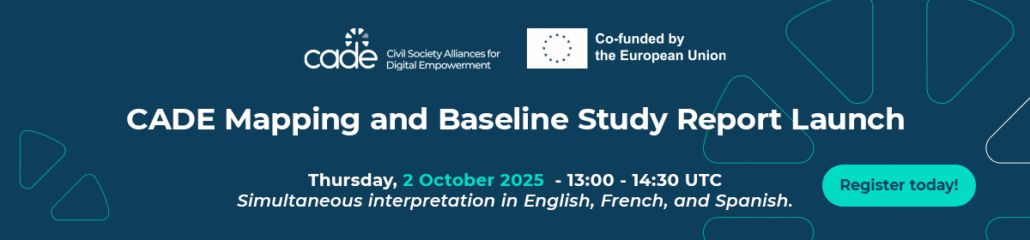
◆ CADE Mapping and Baseline Study Report Launch (2 Oct)
Join Diplo, the lead of the Civil Society Alliances for Digital Empowerment (CADE) consortium, for the official launch of the CADE Mapping and Baseline Study Reports.
The Mapping and Baseline studies shed light on the current landscape, challenges, and opportunities surrounding civil society organisation (CSO) participation in key internet governance spaces – such as the IGF, ICANN, ITU, and IETF – with a special focus on underrepresented voices from the Global South. The studies also offer actionable recommendations to strengthen meaningful and inclusive engagement of CSOs in these critical digital policy processes. Register now!
Blogs and publications
◆ Reporting from the 80th session of the UN General Assembly (UNGA 80)
This just-in-time reporting provides an analysis of the general debate of the 80th session of the UN General Assembly (UNGA 80), held from 23 to 29 September 2025 in New York. It offers an in-depth examination of the proceedings, including a summary of key discussions, a survey of points of agreement and disagreement, and a linguistic analysis. Read the reports!
◆ The strategic imperative of open source AI
This year, open-source AI transformed from an ideological preference into a strategic imperative, a shift echoing a clear lesson from digital history: open systems win. Just as the open protocols of the internet and the collaborative Linux operating system outcompeted closed, proprietary rivals, today’s open AI models are set to dominate. They evolve at a faster speed, their development costs are distributed, and their transparency allows for far superior integration across the economy. Openness is no longer just a principle; it is the winning strategy. Read the blog post!
◆ Why does working in AI often feel ‘schizophrenic’?
Why does AI work feel so paradoxical? It demands two personalities in one: a creative explorer who embraces ambiguity, and a meticulous engineer obsessed with precision. This post unpacks this tension and explains why the future of AI development depends not on finding rare unicorns, but on building great teams. Read the blog post!
◆ Hidden psychological risks and AI psychosis in human-AI relationships
AI is no longer just a tool. Humans are forming deep emotional bonds with it, impacting behaviour, decision-making, and the very way we perceive connection. Read the DW analysis!
◆ When language models fabricate truth: AI hallucinations and the limits of trust
Hallucinations in AI can appear as facts. Learn how flawed incentives and vague prompts create dangerous illusions. Read the DW analysis!
◆ Origins of AI: From neurons to neural networks
As AI penetrates more and more areas of our work, it is a good moment to pause, learn, and understand some background: how AI came to be, who invented it, what it is made of, why it consumes so much power, how it works, and what all the associated terms really mean. Read the blog post!
◆ Understanding the language of modern AI
Just as you learned terms like ‘browser’, ‘download’, and ‘Wi-Fi’ when the internet became mainstream, there are key AI terms that will help you steer this new technological ecosystem with confidence. Read the blog post!
◆ AI in Practice: Real-world applications explained
Now that you understand the origins of AI and the fundamental concepts behind AI, from neural networks to parameters, tokens, and context windows, let’s explore how these technologies are applied in the real world. Read the blog post!
◆ Should the United Nations continue writing reports?
It is a heretical question, but a necessary one. Amid deep soul-searching about the future of multilateralism, the UN Secretary-General has questioned the impact of the thousands of reports the organisation produces. Here are arguments for and against the UN’s reporting obsession, framed in six dialogues. Read the blog post!
◆ Oman: Nexus between traditional and tech diplomacy
How can Oman leverage its rich tradition of mediation and negotiation for the forthcoming AI and tech transformation of diplomacy? How can its cultural heritage as a bridge between the civilisations of the Arab Gulf, the Indian subcontinent, and East Africa help address deeper cultural and religious dimensions within AI systems? Read the blog post!
◆ Arabic philosophical traditions in the AI era
The Arabic philosophical tradition that flourished during the Islamic Golden Age offers insights that remain highly relevant for contemporary AI development, policy, and governance. Read the blog post!
◆ How South Korea’s beauty industry remade its national image
The global ascent of K-beauty has become a quiet but formidable pillar of the Hallyu, or Korean Wave, representing a masterstroke of diplomatic charm. Read the blog post!
◆ Diplomacy in beta: From Geneva principles to Abu Dhabi deliberations in the age of algorithms
This report focuses on the Hili Forum session titled ‘Geneva vs Algorithms: Redefining Laws of War and Peace’, which examined the role of AI and lethal autonomous weapon systems (LAWS) in conflict, and how Geneva-based institutions can guide responsible governance. It also draws on insights from across the Forum, from debates on geopolitical instability to the rise of new coalitions, and the challenges of keeping diplomacy effective in a rapidly evolving, tech-driven world. Read the blog post!
◆ Techno(demo)cracy in action: How a five-day app blackout lit a Gen Z online movement in Nepal
The social media ban, the backlash, the reversal, and the political break sequence have narrated an unexpected digital governance tale. The on-the-ground reality is a clash between a fast-evolving regulatory push and a hyper-networked youth cohort that treats connectivity as livelihood, classroom, and public square. Read the DW analysis!
◆ Reflections on the documentary ‘Abuse in the World of Online Games’
Read the reflections from the unique intersection of being a participant in the documentary, a viewer of the final product, and a legal expert in the field. Read the blog post!
◆ How sports diplomacy lost its innocence
The journey from the ping-pong tables of Beijing to the fraught debates in the conference rooms of FIFA and the IOC is a story of lost innocence. Sport is no longer a gentle prelude to diplomacy; it is a chaotic, high-stakes, and deeply politicised arena, where the contest for influence is as fierce as any match. Read the blog post!
◆ Publications by diplomats: Public diplomacy par excellence
Publications by diplomats are a form of public diplomacy, since they are geared by definition towards an open audience, and thus also help shape public opinion. Read the blog post!
◆ The role of NGOs in shaping foreign policy
NGOs have influenced foreign policy for millennia – from traders in Han China to today’s lobbies and diasporas. The issue is not whether to give them a voice, but what role that voice should play. Read the blog post!
◆ ConfTech Digest #50, August/September
Discover the latest updates in the world of online meetings: personal meeting templates, lobby chat, AI-powered speech translation, new agentic AI capabilities, and more! Read ConfTech Digest #50!
◆ Weekly #231: UNGA80 turns spotlight on digital issues and AI governance
In the latest issue of the DW Weekly newsletter:
- TikTok faces a great American makeover as divestiture reshapes its future
- Apple urged the EU to scrap the Digital Markets Act in favour of a ‘fit for purpose’ alternative
- Amazon agrees to a record USD 2.5 billion settlement, forcing an overhaul of Prime sign-up and cancellation practices
- A cyberattack on Collins Aerospace disrupted operations at major European airports
Latest videos
◆ DW Shorts #31: Why AI is failing scientists, gaming chips are booming, and cars are dying
In this episode: fake AI answers sneaking into scientific databases, Microsoft going full gamer mode, and the not-so-fun reality check for the car industry.

Don’t miss…
◆ UN CSTD WG on data governance
The Digital Watch observatory has just launched a dedicated page on the CSTD Working Group on Data Governance. This new resource provides key updates and background on the Working Group’s discussions, access to documents, and insights into global debates shaping the future of data governance. Explore the page!
◆ AI Policy Summit 2025 (3-4 Oct)
The AI Policy Summit advances to its sixth edition in 2025. The Summit continues the multistakeholder dialogue with leading experts, exploring the use of public policy and societal engagement to capture the benefits of artificial intelligence, minimise its risks, and enhance its adoption. Read more and register!
Subscribe to Diplo's News
The latest from Diplo and GIP
Tailor your subscription to your interests, from updates on the dynamic world of digital diplomacy to the latest trends in AI.
Subscribe to more Diplo and Geneva Internet Platform newsletters!
Diplo: Effective and inclusive diplomacy
Diplo is a non-profit foundation established by the governments of Malta and Switzerland. Diplo works to increase the role of small and developing states, and to improve global governance and international policy development.