As AI penetrates more and more areas of our work, study, and life, it’s being used and adopted by people far beyond the tech-savvy among us. So it’s always a good moment to pause, learn, and understand some background: how AI came to be, who invented it, what it is made of, why it consumes so much power, how it works, and what all the associated terms really mean?
As this website explores the interactions of AI and humans, focusing on the benefits and improvements AI brings to humanity, it’s only appropriate and humane to continually try to explain AI to people, bringing it ever closer and making it less frightening. AI is not a passing tech fad; it’s here to stay. Suppose we want humanity to evolve and progress together with AI. In that case, it will be inevitable to make AI approachable and digestible for everyone, just as people have learned to watch TV or use their phones.
How AI came to be
As we have discovered and learned more about ourselves as humans, one aspect that has probably always been the most fascinating and mysterious is the human brain. Scientists have long sought to research and understand this vital organ. As we have been able to enhance our other capabilities with technology over centuries of human evolution, one area remained, until recently, an unknown frontier.
We enhanced our ability to move by inventing various vehicles. We enhanced our ability to feed ourselves by domesticating animals and learning to grow crops. We enhanced our ability to see by inventing artificial light. We enhanced our capabilities to produce and build by inventing machines and harnessing electricity. Eventually, we were even able to prolong our physical existence by inventing vaccines and medicines, as well as developing awareness about health and well-being.
The last remaining frontier was how to enhance our cognitive capabilities; our thinking, knowledge, and learning. Scientists felt the best approach would obviously be to copy our brains!
Our brains consist of billions of brain cells called neurons, organised into different regions of brain tissue. These neurons are famous not only for existing next to each other, like other cells in our body, but also for forming bonds and connections with one another. These connections are used to communicate by sending electrical impulses and various molecules carrying information. One might say they create a network, a neural network.
So, what if we tried to mimic this neural network artificially by creating interconnected, tiny electronic circuits that would contain digital ‘cells’ communicating with each other in the language of machines: zeros and ones? If we could copy the brain’s structure in such a way, perhaps we could copy its functioning. This was the reasoning scientists had.
The birth and evolution of neural networks
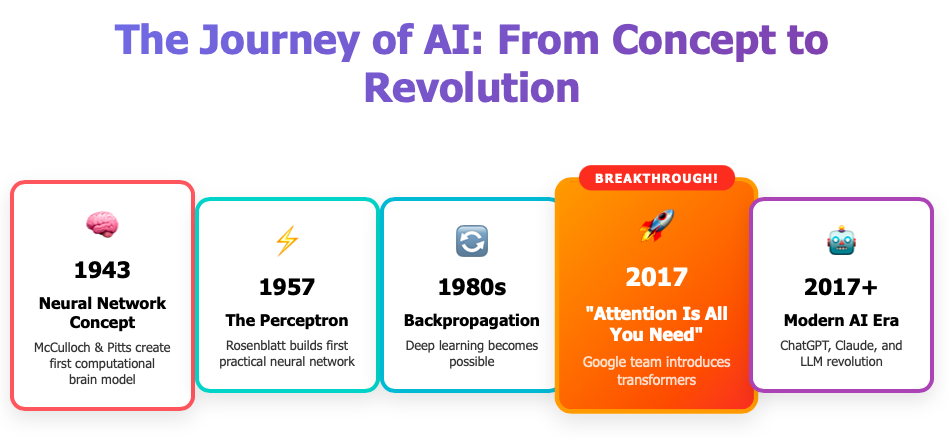
The foundational idea for artificial neural networks was proposed as early as 1943 by Warren McCulloch and Walter Pitts. They created a computational model inspired by how neurons in the brain might work, using electrical circuits to simulate neural activity.
The first practical breakthrough occurred in 1957, when Frank Rosenblatt, a psychologist at Cornell, developed the Perceptron, a simple, single-layer neural network designed for pattern recognition. Throughout the late 1950s and 1960s, other researchers, such as Bernard Widrow and Marcian Hoff, developed systems that applied neural networks to real-world problems, including echo cancellation in phone lines.
However, progress slowed during the 1970s due to limitations in both hardware and algorithms. The real Renaissance began in the 1980s with the development of new learning algorithms, such as backpropagation, which enabled the training of multi-layered (deep) neural networks. However, it was not until significant advancements in electronic technology and the miniaturisation of electronic chips and circuit boards that neural networks reached their full capabilities.
The revolutionary paper that changed everything
Fast forward to 2017, when a team of researchers at Google, led by Ashish Vaswani, published a paper that would transform the AI world: ‘Attention Is All You Need‘. This paper introduced the transformer architecture, a revolutionary way of processing language that would become the foundation for virtually every major AI breakthrough we’ve seen since.
What made transformers so revolutionary? Previous AI models processed text sequentially, word by word, like reading a sentence from left to right and trying to remember everything you’d read before. Transformers introduced a mechanism called ‘self-attention’ that enables the model to simultaneously consider all words in a sentence and understand their relationships, regardless of their position.
How neural networks actually work
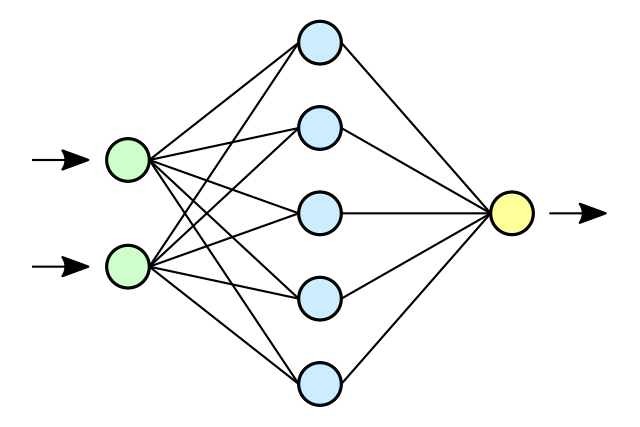
Let’s demystify what happens inside these systems. A neural network is essentially a computing system inspired by biological brains, consisting of interconnected nodes (artificial neurons) arranged in layers. These nodes aren’t physical computer chips, but rather mathematical units implemented in software. Each node performs calculations on the data it receives, applies a mathematical function to determine its output, and passes that result to connected nodes in the next layer, mimicking how real neurons communicate via electrical signals.
Here’s how they process information:
- Input layer: Receives data (whether that’s pixels from an image, words from a sentence, or any other type of information we want the AI to process).
- Hidden layers: This is where the ‘thinking’ happens. Multiple layers process the data using mathematical operations, with each layer learning to recognise increasingly complex patterns. In deep learning, we use many hidden layers (hence ‘deep’), allowing the network to learn sophisticated relationships in the data.
- Output layer: Produces the final result, a classification, prediction, translation, or generated text.
The magic happens through a process called training, where the network learns from massive amounts of data. During training, the system adjusts millions or even billions of internal parameters (weights) to minimise errors in its predictions. It’s like a student practising problems until they master the underlying patterns.
Key concepts you might encounter:
- Backpropagation: The algorithm that teaches networks by working backwards from mistakes to adjust the internal connections
- Activation functions: Mathematical functions that determine how neurons respond
- Deep learning: Using neural networks with many hidden layers to learn complex patterns
Beyond neural networks
While neural networks dominate today’s AI headlines, there are several other approaches to building intelligent systems that don’t rely on deep learning architectures:
- Traditional machine learning uses algorithms such as decision trees, support vector machines, and random forests to identify patterns in data without relying on neural structures.
- Expert systems encode human knowledge as rules and logic.
- Evolutionary algorithms mimic natural selection to solve problems.
- Reinforcement learning trains agents through trial and error, though it often combines with neural networks today.
These approaches continue to play important roles in many applications, particularly where interpretability and reliability are crucial, such as in medical diagnosis and financial systems.

Understanding modern AI: Deep learning and transformers
Now that we know the foundation, let’s examine how today’s most advanced AI systems operate.
When we say that a Large Language Model (LLM) like ChatGPT or Claude is based on ‘deep learning’, we mean that it uses neural networks with many layers, sometimes dozens or even hundreds, to process and generate language.
The transformer revolution
Most modern LLMs use transformer architecture, a specialised type of deep neural network that emerged from that revolutionary 2017 Google paper, which processes text (‘transforms’ input text into understanding and output) through several key innovations:
- Parallel processing: Unlike older models that processed words one by one, transformers analyse all words in a sentence simultaneously. This makes them much faster and more efficient.
- Self-attention mechanism: This is the key breakthrough. The model can focus on different words when processing each part of a sentence. For example, in ‘The cat sat on the mat’, the model can connect ‘cat’ with ‘sat’ and ‘mat’ with ‘on’, understanding relationships regardless of word position.
- Multiple layers working together: An LLM typically contains many transformer blocks, sometimes over a hundred. Each block refines the understanding, allowing the model to learn increasingly sophisticated patterns in language.
- Architecture variants: Different arrangements serve different purposes:
Training on a massive scale
These models learn by training on enormous datasets, often trillions of words from books, websites, and other text sources. During this process, they learn grammar, context, facts about the world, and even reasoning patterns, all by trying to predict the next word in a sequence.
The human element in AI’s future
Understanding how AI works helps us appreciate both its capabilities and limitations. These systems are sophisticated pattern recognition and generation tools, trained on human-created content and designed to assist and augment human capabilities.
Whether you’re using ChatGPT for writing assistance, Claude for analysis, or any other AI tool, you’re interacting with implementations of these transformer architectures, all built upon decades of research showing us that, in the realm of language AI, ‘attention is all you need’.
As AI becomes more integrated into our daily lives, this understanding helps us use these tools more effectively while maintaining realistic expectations about what they can and cannot do. The goal isn’t to replace human intelligence, but to enhance it, keeping humans firmly at the centre of our technological progress.
This is the first in a series exploring AI fundamentals from a human-centred perspective. Next, we’ll dive deeper into the terminology and concepts you’ll encounter as AI becomes part of your daily toolkit.
Author: Slobodan Kovrlija
Click to show page navigation!