CADE Capacity Development Programme for CSOs 2025-2026
Are you part of a civil society organisation (CSO) looking to make a more substantial impact in digital policy?
The Civil Society Alliances for Digital Empowerment (CADE), led by Diplo, is inviting applications for its sponsored (free of charge) 2025–2026 Capacity Development Programme for CSOs, a unique opportunity to strengthen your organisation’s voice in global digital policy. Applications are open until 30 November. Learn more and apply!
Diplo Academy upcoming courses and programmes
🍂 Applications open! Diplo’s 2026 winter online courses
- AI Technology, Policy and Governance
- Diplomatic Communication
- Multilateral Diplomacy Institutional Aspects
- Humanitarian Diplomacy
- Public Diplomacy Essentials
Register now to reserve your place in our specialised winter courses!
👉🏼 Application deadlines for certificates issued by Diplo: 26 January 2026
For further information and to apply, click the course titles above or visit Diplo Academy’s course catalogue.
◆ Need financial assistance? Scholarships are available!
Thanks to support from the government of Malta, partial scholarships are available for applicants from developing countries to attend upcoming Diplo online courses. These scholarships cover 30%–60% of course fees and can be applied to most 2026 online courses. Browse our course catalogue and contact us at [email protected] for further information.
Upcoming events
◆ Gaming and Africa’s Youth: Opportunities, Challenges, and Future Pathways (3 Dec.)
Africa’s youth population, the largest and fastest growing in the world, faces an urgent unemployment challenge. Yet amidst this, a thriving gaming culture is emerging across the continent, fuelled by the digital revolution. Globally, gaming is more than entertainment – it’s a billion-dollar industry creating jobs, exports, and innovation.
Can Africa transform its youth gaming culture into a productive, ethical, and inclusive economic force? Join the discussion on 3 December 2025, 13:00–14:30 UTC. Register now!

◆ Digital inclusion by design: Leveraging existing infrastructure to leave no one behind
In 2024, 2.6 billion people did not use the internet at least once every three months. As economies and societies rapidly digitalise, persistent digital divides often result in digital transformations that mainly benefit easier-to-reach, connected populations, inadvertently deepening inequalities. This event aims to share practical experiences from the ground on leveraging existing infrastructure to connect the unconnected and the hardest-to-reach populations.
The event is co-organised by the Universal Postal Union (UPU), Giga, and Diplo. It is hosted in situ by the Giga Connectivity Centre in Geneva. Learn more!
Blogs and publications
◆ Quipus and chasquis: The Inca internet of diplomacy
Long before fibre-optic cables crisscrossed the planet, a web of knotted cords and mountain runners kept an empire connected. In the high Andes, the Inca civilisation mastered the art of information and communication in ways that remain astonishingly relevant today. Their system still has lessons for today’s digital diplomats. Read the blog post!
◆ Diplomacy on screen: What ‘The Diplomat’ gets right (and wrong)
Netflix’s The Diplomat has captured the attention of audiences and international relations professionals alike. While fictional, it’s a portrayal of the many facets of modern diplomacy, and a great case study in how a single envoy must navigate cultural, public, coercive, and crisis diplomacy, often all at once. Read the analysis of what the series gets right (and wrong) about bilateral vs multilateral negotiations, how it depicts the tension between ‘front-stage’ performance and ‘back-channel’ deals, and a key element of modern statecraft the series has (so far) overlooked. Read the blog post!
◆ Contribution of publications by diplomats to comparative development
Diplomats’ journey is one of perpetual comparison by virtue of their profession, living in one country yet representing another. When they publish, the element of comparison is almost inherent in their writings. Read the blog post!
◆ The diplomat’s bookshelf: Your 2025 reading list
In an age of brain rot and endless scrolling, reading isn’t just resistance; it’s a strategy. These novels aren’t escapism; they’re blueprints for understanding the diplomatic tools shaping our world. Read the blog post!
◆ AI and the moral compass: What we can do vs what we should do
AI offers extraordinary power to create, decide, and optimise, and yet its most significant challenge is moral, not technical. The tension between what we can do and what we should do is as old as civilisation itself, from the Garden of Eden to the age of algorithms. As AI begins to touch every domain of human life, the task before us is not only to regulate it, but to cultivate wisdom equal to its power. Read the blog post!
◆ AI, automation, and human dignity: Reimagining work beyond the paycheck
As automation and AI transform entire industries, the real challenge lies not just in job loss but in preserving human dignity, purpose, and meaning in work. A humane approach to this transition must prioritise dignity-first design, accessible adaptation, and a redefinition of what counts as valuable human contribution, ensuring that technology serves human flourishing, not just efficiency. Read the blog post!
◆ The AI soldier and the ethics of war
AI is transforming warfare from a human-driven struggle into a machine-guided simulation, raising urgent questions about the future of ethics, accountability, and humanity on the battlefield. Read the DW analysis!
◆ The rise of large language models and the question of ownership
Balancing open access and corporate ownership of these models will determine whether AI becomes a shared global good or a private monopoly. Read the DW analysis!
◆ The ‘Limits of Growth’ report: 40 years later I
This post, first published in 2012, revisited the 1972 Limits of Growth report, which predicted civilisation’s collapse by c. 2040. Fifty years on, the author’s analysis of enablers – not equations – feels more relevant than ever. Read the blog post!
◆ Digital Watch Monthly – Issue 104 – October 2025
In our October 2025 issue, we unpacked new rules for children’s online spaces and examined the global struggle to steer AI. We analysed shifting rare-earth supply chains and what recent cloud outages reveal about digital resilience. We also looked back at the signing of the UN Cybercrime Convention. We also recapped key Geneva events shaping the future of international digital governance. Read Digital Watch Monthly #104!
◆ Weekly #238: Strengthening democracy in the digital age: The EU’s New ‘Democracy Shield’
In the latest issue of the DW Weekly newsletter:
- The EU’s New ‘Democracy Shield’
- Highlights from the WSIS+20 Rev 1 document
- The EU’s revised Chat Control proposal
- An EU-UK-Australia alliance on protecting children online
- NYT vs OpenAI
◆ ConfTech Digest #52, October/November 2025
Discover the latest updates in the world of online meetings: full HD (1080p) streaming, multiple camera views, live-caption translations, Audio Recap, a full emoji library for reactions, a countdown timer, an improved waiting room, tasks, and more. Read ConfTech Digest #52!
Latest videos
◆ AI Shorts: #23 Claude’s Climb, Amazon’s Cuts, Microsoft’s AGI Trigger
In the latest episode of AI Shorts:
- Claude is quietly winning the AI race
- Amazon’s AI innovation and job cuts
- Microsoft and OpenAI now have an AGI panel

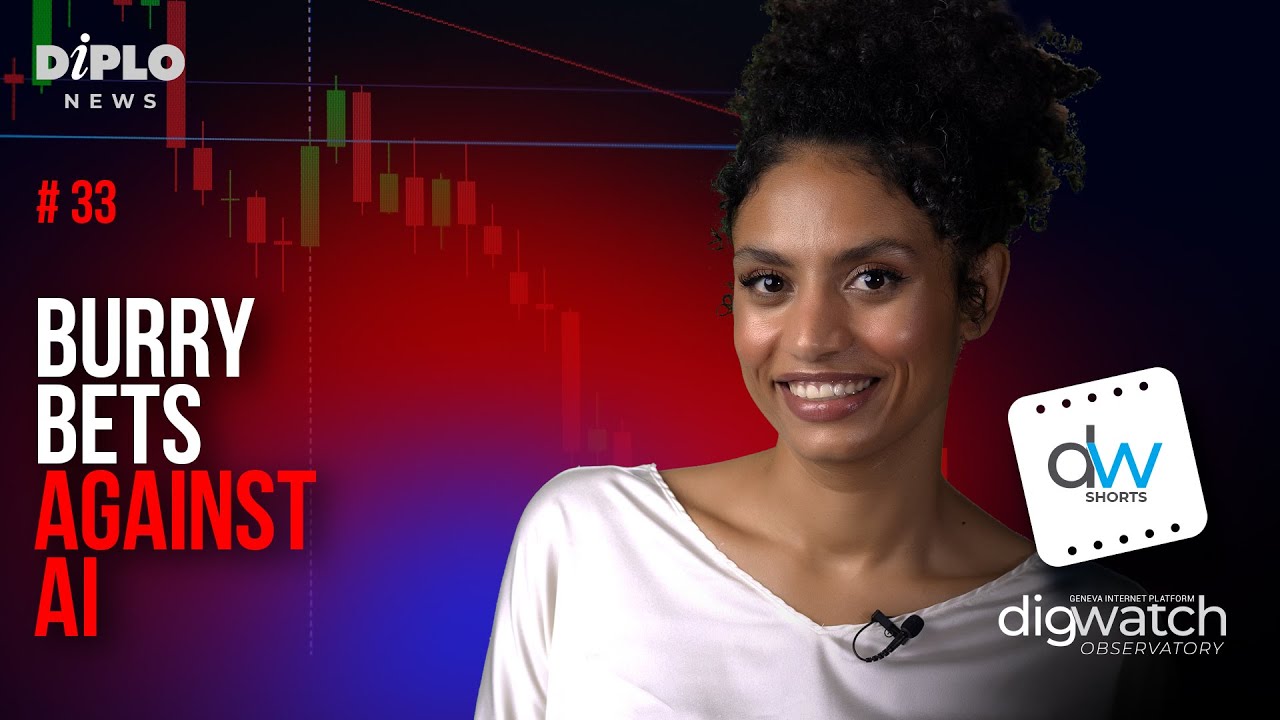
◆ DW Shorts #33: Burry bets against AI
In the latest episode of DW Shorts: Michael Burry thinks the AI market’s air is getting thin. Do you agree, or is this just another contrarian play?
Don’t miss…
◆ The Diplomat’s Pen: An exhibition in Krakow illuminates the literary tradition of Italian diplomacy
The exhibition reveals the often-unseen creative dimension of those dedicated to representing their nations abroad. Running until the end of the year at the Faculty of International and Political Studies of the Jagiellonian University, this undertaking is the result of cooperation between the university’s research team, the Italian Cultural Institute in Kraków, and Amb. Stefano Baldi, who conceived and guided the Italian section. The exhibition is held under the Honorary Patronage of the Embassy of Italy in Warsaw. Learn more!
Subscribe to Diplo's News
The latest from Diplo and GIP
Tailor your subscription to your interests, from updates on the dynamic world of digital diplomacy to the latest trends in AI.
Subscribe to more Diplo and Geneva Internet Platform newsletters!
Diplo: Effective and inclusive diplomacy
Diplo is a non-profit foundation established by the governments of Malta and Switzerland. Diplo works to increase the role of small and developing states, and to improve global governance and international policy development.