This year, 11 candidates graduated Master in Contemporary Diplomacy from the University of Malta and DiploFoundation. The graduation ceremony took place at the Jesuit’s Church in Valletta, Malta.
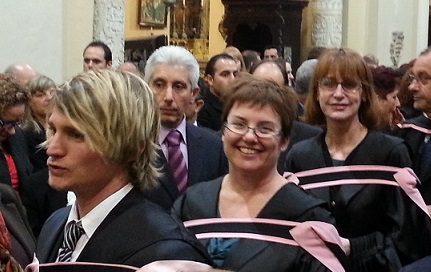
The graduates and their research topics were: Benjamin Wako Mukabire (Regulation Of Regional Trade Agreements: A Critical Review Of The East African Community), Catherine Farrugia (EU-Turkey Negotiations: Obstacles to Turkey’s application to join the EU), Garry Cronan (Diplomacy and policy development in the Web 2.0 Age and beyond: An analysis of Open Government and Open Data approaches), Virginia Paque (Internet governance (IG) as a diplomatic priority), Kai Sonda Brima (Democracy in Ghana: Lessons for Africa), Markus Koller (A review of the diplomatic relations between the Islamic Republic of Iran and the USA), Mary Murphy (The impact of the Internet on diplomatic reporting: how diplomacy training needs to be adjusted to keep pace), Roxie K. McLeish-Hutchinson (The diaspora as a resource for sustainable development: A case study of Grenada), Phakamisa Siyothula (The Role of the Civil Society in Contemporary Disarmament Diplomacy: A Comparative Analysis of the campaigns and negotiations to ban landmines and cluster bombs), Ene Tammy Abah (The Role of Diplomacy in the Security Situation in the North of Nigeria: Case Study of Boko Haram) Ezra Zilla Natasha Thomas (The Evolution of Diplomacy in the Caribbean).
We would like to thank the Diplo faculty members who supervised the work of these graduates.
Read The Times of Malta article on the graduation ceremony here.

“Diplomats are professionally expected to be most representative of their country. yet by function of their very own profession they may live in it the least”(Aljowaily, Amr, 2020, p98) Repre[...]
Public diplomacy is often differentiated from “traditional diplomacy” whereby the former is primarily an activity to engage with the public, while the latter is mainly focused on governmen[...]
Diplo Academy excelled in e-learning in 2023, delivering 20 courses with a 92% completion rate. The academy prioritized diversity, with nearly half of participants being female and most coming from de[...]
The text discusses intercultural communication through the lens of logical fallacies, particularly focusing on hasty generalizations and stereotypes. It questions the impact of generalizations in inte[...]
In 2014, Narendra Modi proposed an International Yoga Day at the United Nations, focusing on the holistic benefits of yoga beyond exercise, including addressing climate change. The diplomatic campaign[...]
The message provides a detailed overview of Angela Merkel's time in office and her impact. It covers her tenure, notable events she faced, her leadership style, and the challenges her successor must t[...]
The Covid-19 pandemic has led to the cancellation of face-to-face diplomatic talks, prompting the increased use of video-conferencing as an alternative. While video-conferencing saves time and money, [...]
The WebDebate highlighted the challenges and opportunities of intercultural relations in diplomatic practice regarding immigration. Speakers discussed the need to humanize immigration, emphasizing the[...]
The text discusses the potential for utilizing economic diplomacy to drive domestic reforms, focusing on the Philippine context. The author reflects on the evolving role of diplomats in shaping econom[...]
Dr. Atef Ahmed emphasizes the importance of using literature, especially works by authors like Naguib Mahfouz and Laura Z. Hobson, to foster cultural understanding between Arabs and Jews. He believes [...]
In a post by Shaun Riordan, the debate over various types of diplomacy is addressed. The concern raised is the potential dilution of the concept if everything is labeled as diplomacy. The discussion t[...]
Standards are essential in everyday life and can shape habits, making life easier. The WebDebate discussed the importance of standardization in facilitating daily activities, supporting sustainable de[...]
This dissertation analyses the organisation of the external action structures of the European Union. As an international actor which is beyond a stat... Read more
Cyberwarfare has emerged from the expeditious expansion of the Internet as a new mode of conflict that can anonymously and remotely disrupt the core f... Read more
The dissertation will focus on the birth and present state of existence of Lesotho, as a nation state, a state inside another state, looking at how di... Read more
This paper assesses the relevance of ethnicity and power in conflicts occurring in the EAC and SADC regions through a case study of Kenya. It engages ... Read more
The adoption of open data policies and the standardization of data collection were among the recommendations made during DiploFoundation's Data Diplom... Read more
I started writing a memoire in 1998, but on a long train journey in Germany (Stuttgart to Essen), accompanied by my wonderful wife Mimi, a thought cam... Read more
In 2005, I reviewed the third edition of Diplomacy: Theory and Practice by G.R. Berridge as essential reading for Robinson Crusoe, had he been a stude... Read more
Over the last 20 years, the Internet has changed the ways in which we work, how we socialise and network, and how we interact with knowledge and infor... Read more
Peacetime Regime for State Activities in Cyberspace (ed by Katharine Ziolkowski) covers in a multi-disciplinary approach the technical, legal, policy... Read more
The Dutch government is making investments in the modernization of its diplomatic services to enhance its efficiency, effectiveness, and digital capab... Read more
The latest from Diplo and GIP
Tailor your subscription to your interests, from updates on the dynamic world of digital diplomacy to the latest trends in AI.
Subscribe to more Diplo and Geneva Internet Platform newsletters!